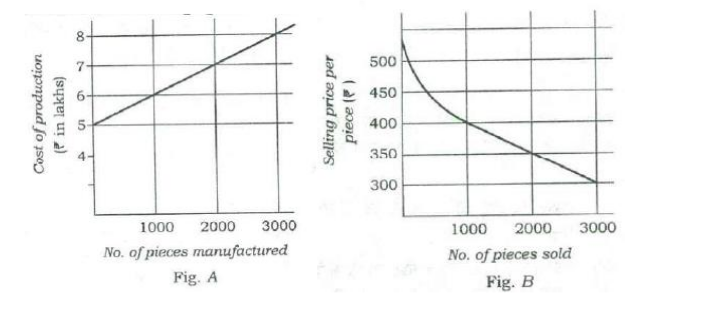
Consider figures A and B showing manufacturing cost and projected sales for a product respectively. What is the minimum number of pieces that should be manufactured to avoid a loss?
The correct answer is (A) 2000.
Explanation:
To determine the break-even point (where no loss occurs), we first find the equations for Total Cost (TC) and Total Revenue (TR) from the given graphs: 1. Manufacturing Cost (Figure A): - At q = 0 pieces, the fixed cost is ₹ 20,000. - At q = 1000 pieces, the total cost is ₹ 30,000. - This gives a variable cost per piece of (30,000 - 20,000) / 1000 = ₹ 10. - Thus, TC = 20,000 + 10 × q. 2. Projected Sales (Figure B): - At q = 1000 pieces, the sales revenue is ₹ 18,000. - This gives a selling price per piece of 18,000 / 1000 = ₹ 18. - Thus, TR = 18 × q. To avoid a loss, the revenue must be at least equal to the cost: TR = TC 18 × q = 20,000 + 10 × q 8 × q = 20,000 q = 20,000 / 8 = 2500. Thus, the minimum number of pieces to avoid a loss is 2500, which corresponds to option B.
हिंदी में प्रश्न एवं आदर्श उत्तर
क्रमशः चित्र A और B में किसी उत्पाद की निर्माण लागत और प्रक्षेपित बिक्री दिखाई गई है। कम-से-कम कितने अददों का निर्माण किया जाना चाहिए ताकि हानि न हो?
सही उत्तर (A) 2000 है।
व्याख्या:
To determine the break-even point (where no loss occurs), we first find the equations for Total Cost (TC) and Total Revenue (TR) from the given graphs: 1. Manufacturing Cost (Figure A): - At q = 0 pieces, the fixed cost is ₹ 20,000. - At q = 1000 pieces, the total cost is ₹ 30,000. - This gives a variable cost per piece of (30,000 - 20,000) / 1000 = ₹ 10. - Thus, TC = 20,000 + 10 × q. 2. Projected Sales (Figure B): - At q = 1000 pieces, the sales revenue is ₹ 18,000. - This gives a selling price per piece of 18,000 / 1000 = ₹ 18. - Thus, TR = 18 × q. To avoid a loss, the revenue must be at least equal to the cost: TR = TC 18 × q = 20,000 + 10 × q 8 × q = 20,000 q = 20,000 / 8 = 2500. Thus, the minimum number of pieces to avoid a loss is 2500, which corresponds to option B.