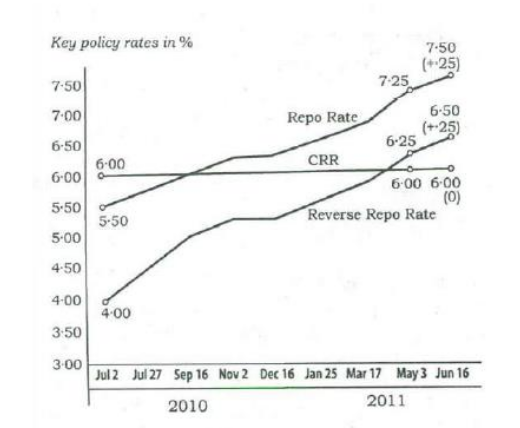
The graph given below indicates the changes in key policy rates made by the Central Bank several times in a year. Which one of the following can be the most likely reason for the Central Bank for such an action?
Correct Option: Anti-inflationary stance
The graph depicts a series of consecutive upward revisions in the key policy rates (such as the repo rate) made by the Central Bank within a year. In central banking and macroeconomics, raising key policy rates is a standard monetary tightening tool. By increasing these rates, the Central Bank makes borrowing more expensive for commercial banks, which in turn increases lending rates for businesses and consumers. This reduces the money supply and liquidity in the economy, cooling down aggregate demand and controlling rising price levels. This action is classically defined as an anti-inflationary stance. Option A is incorrect because higher interest rates do not primarily aim to encourage foreign investment directly. Option B is incorrect because raising rates decreases liquidity rather than increasing it. Option C is a secondary effect and not the primary policy goal of multiple rapid rate hikes. Thus, Option D is the correct choice.
हिंदी में प्रश्न एवं आदर्श उत्तर
नीचे दिए गए आलेख में एक वर्ष की अवधि में केन्द्रीय बैंक द्वारा प्रमुख नीतिगत दरों में अनेक बार किए गए परिवर्तनों को दिखाया गया है। निम्नलिखित में से कौन-सा एक केन्द्रीय बैंक की इस कारवाई का सबसे संभव कारण है?
सही उत्तर: स्फीति-विरोधी कदम
यह आलेख एक वर्ष की अवधि में केन्द्रीय बैंक द्वारा प्रमुख नीतिगत दरों (जैसे रेपो दर) में लगातार की गई वृद्धि को प्रदर्शित करता है। समष्टि अर्थशास्त्र (macroeconomics) में, नीतिगत दरों में वृद्धि करना मौद्रिक नीति को कड़ा करने का एक मानक साधन है। जब केन्द्रीय बैंक दरों को बढ़ाता है, तो वाणिज्यिक बैंकों के लिए ऋण लेना महंगा हो जाता है, जिससे वे भी उपभोक्ताओं और व्यवसायों के लिए ऋण की दरें बढ़ा देते हैं। इसके परिणामस्वरूप अर्थव्यवस्था में तरलता और धन की आपूर्ति कम हो जाती है, जिससे कुल मांग में कमी आती है और मूल्य वृद्धि (मुद्रास्फीति) पर नियंत्रण पाया जाता है। केन्द्रीय बैंक के इस कदम को "स्फीति-विरोधी कदम" (Anti-inflationary stance) कहा जाता है। विकल्प A गलत है क्योंकि नीतिगत दरों में बार-बार वृद्धि का मुख्य उद्देश्य विदेशी निवेश को आकर्षित करना नहीं होता। विकल्प B गलत है क्योंकि दरें बढ़ाने से तरलता घटती है, बढ़ती नहीं। विकल्प C भी प्रमुख उद्देश्य नहीं है। अतः विकल्प D सही उत्तर है।